
You're standing in a dusty lot outside Austin, your bike is ticking as it cools, and a stranger in a leather vest nods at you like you've been friends for a decade. Nobody warned you about that part. The first rally I rode into, I spent the whole weekend terrified I'd commit some invisible sin — park in the wrong row, wear the wrong patch, say the wrong thing. I needn't have worried. But I did need a few things explained to me first, and most rally guides out there don't bother.
This is about the Southwest specifically — Texas, Arizona, New Mexico, Nevada, Utah — because a biker rally in this corner of the country is a different animal from Sturgis or Daytona. The distances are longer, the heat is genuinely dangerous, and the stretches between gas stations can hit you harder than any event schedule ever will. If you're riding your first rally this season, here's what I wish someone had told me before I pointed my front wheel west.
Key takeaways
- The Southwest's defining challenge isn't the rally — it's the ride there: desert heat, altitude, and long gaps between fuel.
- Learn the unwritten biker code before you arrive; you'll be judged far more on respect than on your bike.
- Book lodging early: rally towns in this region have far fewer beds than riders.
- Know the hand signals — two fingers down is the greeting, and it means more than you think.
- Hydrate like it's a job. Dehydration on a motorcycle in 40 °C heat is not a small inconvenience.
Why the Southwest is a different kind of rally
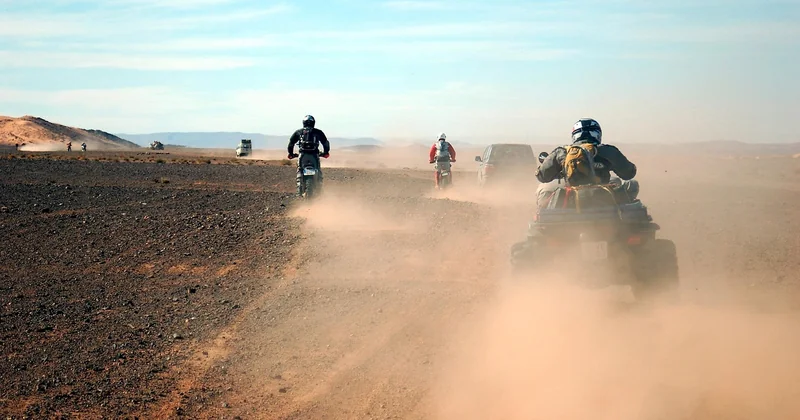
Most rally advice assumes you can roll out of a motel at 9 a.m., ride two hours, and be at the gate by lunch. In the Southwest, that math falls apart. The region's rallies are spread across hundreds of miles of desert and mountain, and the ride between them is half the experience — and most of the risk.
The heat is not negotiable
Summertime temperatures across Arizona, southern Nevada, and West Texas routinely climb past 40 °C (over 100 °F) by midday. On a motorcycle you're not sitting in air conditioning — you're sitting in a wind tunnel of hot air, and the wind actually dehydrates you faster than standing still. I made the mistake of skipping a water stop on a stretch near the Nevada line during my first big trip. By the time I pulled in, I had a headache I couldn't shake and my hands were shaking. That's mild heat exhaustion, and it came on without me noticing.
Plan your riding for early morning and late afternoon. Carry more water than feels reasonable. Wear gear that vents — not shorts and a t-shirt, however tempting the forecast looks.
Altitude and empty miles
New Mexico and Utah will throw elevation at you without warning. A carbureted bike runs rich up high; even fuel-injected engines lose a little punch, and you will too. The bigger issue, honestly, is fuel. There are stretches out here where the next open station is 80 to 100 miles away, and some close early or don't take cards. I top off every chance I get now — a habit I picked up after nearly running dry on a two-lane road with no cell signal and no traffic.
The lesson: treat every gas station as your last. The Southwest rewards paranoia.
Which Southwest rallies should a beginner target?
Not all rallies are created equal for a first-timer. Some are massive and overwhelming; others are small enough that you'll know half the crowd by Sunday. Here's a rough map of the major players in the region and what to expect.
| Rally | Region | Vibe / scale | Good for beginners? |
|---|---|---|---|
| Arizona Bike Week | Phoenix area, AZ | Large, vendor-heavy, big concerts | Yes — well-organized, lots to see |
| Laughlin River Run | Laughlin, NV | Mid-size, river-town setting | Very good — compact, walkable |
| ROT Rally | Austin, TX | Large, Texas-sized, music-driven | Yes, but book early |
| Local NM/UT rides | Various | Small, community-run | Best for learning the culture |
The ROT Rally and Austin in 2026
The Republic of Texas Rally — ROT, to everyone who goes — is the big Texas draw, held in the Austin area and built around music, vendors, and a whole lot of chrome. If you're planning for this season, the practical advice is the same every year: tickets and camping go early, and Austin-area lodging fills fast because the rally overlaps with the city's usual summer crowds. Check the official ROT Rally channels for the confirmed 2026 dates and location map rather than trusting a random event listing — schedules shift, and I've seen people show up on the wrong weekend because they booked off an old blog post.
For a beginner, ROT is a good introduction because it's big enough to feel like a real event but organized enough that you won't get lost. Just don't expect to wing the accommodation.
The smaller rallies nobody talks about
Honestly? My best first-rally experiences were the small ones. A community ride in rural New Mexico with maybe 200 people taught me more about biker culture in one weekend than any giant event did. Smaller crowds mean people actually talk to you. Vendors have time to answer questions. You can watch how experienced riders behave before you're expected to blend in.
If you're nervous, start small. The big rallies will still be there next year.
The unwritten biker code: what you actually need to know
Nobody hands you a rulebook at the gate, which is exactly why first-timers panic. So let's answer the question people ask me most.
What is the unwritten biker code?
The unwritten biker code is the set of informal expectations that govern how riders treat each other on the road and at rallies — respect, mutual help, and not making a spectacle of yourself. In practice it comes down to a few things: you don't touch another rider's bike without asking, you help a stranded rider if you can, you don't ride aggressively around the group, and you show respect for patches and club colors by not pretending to belong to something you don't. It's less about rules than about not being a jerk, which sounds obvious until you watch someone rev their engine through a quiet campsite at 2 a.m.
The patch thing deserves a note. Club colors mean something specific, and wearing a patch that mimics a real club — even innocently — can cause genuine offense. If you're not in a club, don't dress like you are. Plain leather is always safe.
What does two fingers down mean to bikers?
Two fingers extended downward — usually the index and middle finger of the left hand, held low as you pass another rider — is a greeting and a sign of solidarity. It's a casual "hey, ride safe" between motorcyclists, exchanged on the road without stopping. You don't have to return it, but it's friendly to. I'll admit I fumbled my first few attempts, waving like I was hailing a taxi. Keep it low and relaxed. It's not a salute; it's a nod with your hand.
What is the 12 second rule on a motorcycle?
It's a following-distance and awareness guideline: keep your eyes roughly twelve seconds ahead of where you are, scanning the road for hazards before you reach them. The idea is that at highway speed, twelve seconds of lead time gives you room to react to a pothole, a merging truck, or debris in your lane. It's not a hard number written into law — it's a mental habit taught in rider training, and it has saved me more than once on unfamiliar desert roads where sand drifts across the pavement without warning.
What do you call a girl who rides on the back of a motorcycle?
The common term is pillion — or "pillion passenger." You'll also hear "backseat rider" or, in older biker slang, "old lady," though that last one is dated and plenty of riders don't care for it. The honest answer: a passenger is a passenger, and most people at a rally will just call her by her name. Plenty of women ride their own bikes anyway, so assuming the person on the back isn't the rider is a quick way to look out of touch.
Practical logistics for your first Southwest rally
Here's where beginners lose the most time and money — not on the ride, but on the planning.
Book like your trip depends on it
Rally towns in this region are small. A place that hosts a few thousand riders might have a few hundred motel rooms. That gap is why prices spike and why the good spots vanish months out. Book lodging and any camping passes as soon as dates are confirmed. If you're riding to ROT, sort your Austin accommodation the same week you decide to go. I learned this the hard way and once drove 40 miles back to my campsite at midnight because every room within reach was full.
Pack for the desert, not the postcard
A short, honest packing list for a Southwest rally:
- At least two liters of water capacity on the bike — more if you're crossing open desert
- A proper tool kit and a tire repair kit; cell coverage is patchy off the interstates
- Sun protection that works at speed: a face covering, sunglasses, and gloves
- Cash, because not every rural station or vendor takes cards
- A lightweight rain layer — desert storms arrive fast and hit hard
Notice what's not on there: a huge list of gadgets. Every extra item is weight and distraction. The Southwest rewards riders who travel light and stay alert.
Safety and etiquette on the road
The best rally memory you'll make is the one where nothing goes wrong. A few things worth internalizing before you go.
Ride within your limits, especially in a group. Ego causes more crashes at rallies than bad roads do. If the pace feels too fast, drop back — nobody worth knowing will judge you for it. And when you're riding alongside strangers in a pack, hold your line, signal your intentions, and don't weave. The riders around you are trusting you to be predictable.
Carry your documents, know your bike's range, and tell someone your route if you're riding solo through remote country. Out here, being unreachable for a few hours is normal — being unreachable and unaccounted for is not.
The part nobody tells you
The rallies are the excuse. The reason people keep coming back to the Southwest, year after year, isn't the vendors or the concerts or the sheer scale of the events. It's a stretch of road at sunrise, somewhere past the last town, when the air is still cool and the desert is doing that thing where it looks like it goes on forever. You'll be alone out there, or nearly so, and then a rider you've never met will pass you and drop two fingers, and you'll understand why people plan their whole year around this.
The guidelines matter. The code matters. Book the room, check the water, learn the signals. But leave room in the plan for the moment when the rally stops being an event and starts being the reason you ride. That's the part worth the miles.

