Walk into any motorcycle gear shop and you'll see two kinds of customers. The first wants the safest jacket on the rack, colour be damned. The second wants the jacket that looks best in a photo, and asks whether the armour is "really necessary." Both are missing the point, and I say that as someone who used to be the second guy — until a 40 km/h slide on gravel near a roundabout in the Ardennes taught me what a cheap textile jacket actually does when it meets asphalt. Nothing good. My forearm looked like grated cheese for three weeks.
Biker fashion basics aren't about choosing between function and style. That framing is a trap, usually pushed by people selling either a €900 fashion leather that would disintegrate in a crash or a fluorescent safety suit that makes you look like a traffic cone. The real biker style is what happens when protective kit is cut well enough that you want to wear it off the bike too — and that's exactly the space this article lives in.
Key Takeaways
- Function first is not a compromise — it's the aesthetic. Real biker gear looks good because it was built for a purpose.
- Leather, waxed denim, heavy canvas and dark tones form the visual core; armour, abrasion resistance and ankle coverage form the invisible core.
- You can build a full biker look from four or five pieces. Nobody needs a wardrobe.
- Club patches and colours are identity markers, not costume accessories. Wear them only if they're yours.
- Budget matters less than fit and layering. A well-fitted mid-range jacket beats a badly fitted premium one every time.
What is biker style, really?
Strip away the Instagram mood boards and biker style comes down to one principle: every garment earns its place by doing a job. The leather jacket exists because leather resists abrasion. The boots are tall because ankles break. The dark colours are partly a practical choice — road grime, oil, weather — and partly a cultural one that hardened over decades.
That's the honest definition. Biker style is workwear-adjacent clothing shaped by the physics of falling off a moving vehicle at speed.
Which explains why cheap imitations always feel slightly wrong. They copied the shape and dropped the reason. A £60 faux-leather jacket from a high-street chain has the zip, the collar, the epaulettes — and no abrasion resistance whatsoever. It's a costume. It photographs fine. It protects nothing.
How modern biker style differs from the classic version
The core look hasn't moved much, but the materials have. When I started paying attention to gear around 2021, protective denim was still a niche thing sold in two or three specialist shops. Now you can find riding jeans with aramid fibre linings in mainstream stores, and waxed cotton jackets that pass real abrasion tests while looking like something you'd wear to a pub.
Spoiler alert: this is good news for anyone who wants the look without the crash-test compromise. The gap between "fashion biker jacket" and "certified riding jacket" has narrowed enough that you genuinely don't have to pick.
What are some examples of biker outfit styles?
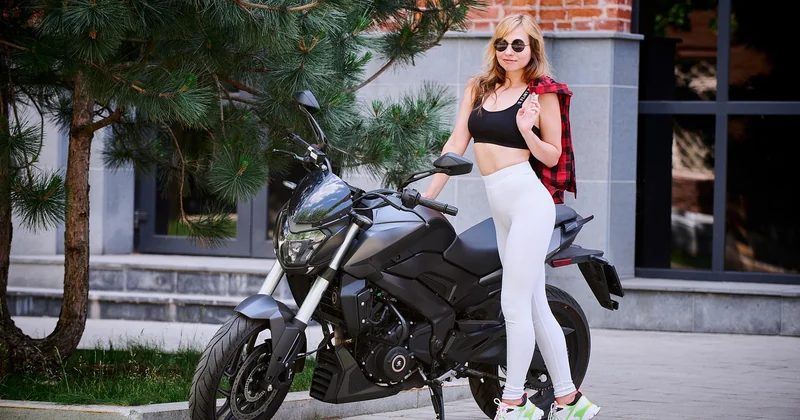
There isn't one biker look. There are at least five distinct ones, and they read very differently depending on how you combine them. Here's how I'd break them down.
The café racer look
Minimal, sharp, slightly retro. Think a close-fitting leather or waxed jacket, straight-leg dark denim, and a low-profile boot. No logos, no fringe, no chrome. This is the easiest entry point for most people because it works off the bike — I've worn a café racer jacket to client meetings in winter and nobody clocked it as motorcycle gear.
The classic cruiser look
Heavier silhouette. Longer jacket, chunkier boots, often a black-on-black palette with silver hardware. This is the style most people picture when they hear "biker," and it's the one with the strongest cultural weight. It also flatters broader frames better than the café racer cut does.
The streetwear crossover
This is where things got interesting over the last few years. Biker jackets over hoodies. Leather trousers paired with chunky trainers instead of boots. Moto gloves worn as an accessory in cold weather. It borrows the vocabulary of riding gear and removes the riding.
My honest opinion: this crossover is fine, and it looks good, but be clear about what it is. A streetwear biker outfit is fashion inspired by function, not functional clothing. If you're actually getting on a bike, the rules change completely.
Biker outfits for ladies
The core pieces are identical to the men's version — jacket, dark denim, boots — but the fit conventions differ. Cropped jackets sit better on shorter torsos. High-waisted riding jeans solve the "jacket rides up when I'm leaned forward" problem that a lot of women hit with men's-cut trousers. And a properly fitted women's glove makes an enormous difference to hand fatigue, because the palm width and finger length are genuinely different.
And no, you don't need a pink version of anything. The whole point of the aesthetic is that it's unisex.
What is the 3-3-3 rule for clothes?
The 3-3-3 rule is a styling shortcut: three colours, three pieces, three textures. You build an outfit from no more than three colours, roughly three visible garment pieces, and three contrasting materials. It stops outfits from becoming visual noise.
It's not a rigid law — it's a guardrail. And it maps onto biker style almost perfectly, which is probably why the look reads as coherent even when the wearer hasn't thought about it.
Applying the 3-3-3 rule to a biker outfit
Here's a concrete formula I use constantly:
- Colours: black, charcoal, and one accent — worn brown, oxblood, or a muted grey.
- Pieces: jacket, jeans, boots. That's it. The helmet and gloves don't count as style pieces, they're equipment.
- Textures: smooth leather, matte denim, and something rougher — waxed canvas, suede, or knit.
Try it with a mid-weight leather jacket, indigo-black riding jeans and a plain knit underneath. Three colours, three core pieces, three textures. It works every time, and it takes about forty seconds to assemble.
Where the rule breaks: summer. In July, the texture layer disappears and you're down to two materials, which can read flat. That's when you swap the knit for a linen-blend tee and lean on the contrast between leather and cloth.
What is a biker's girlfriend called?
In club culture, the long-standing term is "old lady" — an affectionate piece of insider slang rather than an insult, though it sounds harsh to outside ears. It refers to a rider's committed partner, someone who's part of the community without necessarily riding herself.
What it does not mean is the "biker girlfriend" aesthetic you see all over social media — the leather mini-skirt, the crop top, the impractical heels. That's a styling trope, invented by fashion, and it has almost nothing to do with how women in riding communities actually dress. Real partners of riders wear the same weatherproof, ankle-covering, windproof kit as everyone else, because they're sitting on the back of a bike at 120 km/h and cold is cold.
One caution: terminology varies a lot by country and by club, and some of it is genuinely loaded. If you're writing fiction or trying to describe a particular scene, listen to how people in that scene actually talk before reaching for a label.
How to choose kit that's both protective and wearable
Here's where I'll take a firm position. Buy certified protection, then style around it. Not the other way round. I learned that the expensive way, and the cheap jacket I destroyed on gravel cost me far more in the long run than the good one I replaced it with.
What to check before you buy anything
Four things, in this order:
- Shoulder, elbow and back armour — and whether the back protector is included or sold separately. It's often sold separately, which is how a €200 jacket quietly becomes a €280 jacket.
- Abrasion rating. Riding gear sold in Europe carries a CE certification for abrasion resistance. If a jacket has no rating, it's a fashion item.
- Fit at the wrist and waist. Loose cuffs flap, and flapping is exhausting over a two-hour ride. I lost a full weekend of riding once to a jacket that was one size too big in the shoulders.
- Ankle coverage on the boots. Above the ankle, always. This is the one place where I'd refuse to compromise on style at all.
The budget reality nobody mentions
You can dress well on a biker vibe for surprisingly little. A second-hand leather jacket from a decent brand, properly conditioned, will outlast three new fast-fashion versions. Waxed cotton jackets improve with age in a way synthetic ones never do. And a pair of heavy-soled boots with ankle support costs less than a single designer t-shirt.
Where the money genuinely matters is armour and abrasion certification. That's the part I wouldn't economise on. Everything else is negotiable.
Field notes
- If it has no abrasion rating, it's a costume, however good it looks.
- Second-hand leather in good condition is the best value in biker fashion, full stop.
- Fit beats price. A well-fitted mid-range jacket is safer and looks better than a baggy premium one.
The look that survives the crash
There's a reason this aesthetic has outlived every trend cycle since the 1950s. It wasn't designed to be flattering or fashionable — it was designed to keep a human body intact at speed. The fact that it also happens to look good is a happy accident of engineering.
Which means the "function meets style" question answers itself. When you buy well, you're not choosing two things. You're buying a jacket that will look better in five years than it does today, and that will still be intact if you ever need it to be. That's a rare combination in clothing, and it's why I stopped bothering with anything else.
The only question worth asking is whether the kit on your back would do its job on the worst day. If the answer is yes, the style is already there. If the answer is no, no amount of mood boarding will fix it.