You're standing in your hallway at 11 p.m., saddlebag in one hand, a strap in the other, trying to work out whether the thing will actually clear your rear tyre or just rub against it for eight hours straight. I know that moment well. I've had it in three different countries, with four different bags, and once with a bag that turned out to be designed for a completely different kind of bike.
Here's the awkward truth about choosing the right saddlebags for road trips: the same search term covers two things that have almost nothing in common. On one side, the small under-saddle bag cyclists use for a multi-tool and a spare tube. On the other, the lateral panniers a motorcycle tourist straps on for a two-week run across a continent. Most guides blur them together. Let's not.
Key Takeaways
- Clarify first which bag you actually need: a cycling saddle bag (0.3–1.5 litres) or motorcycle saddlebags (10–30 litres each). The advice is not transferable.
- Volume should follow trip length, not ambition. A day ride needs less than one litre of storage under the saddle.
- Clearance is the number one cause of failure, not fabric quality: check saddle rail space, tyre radius, and rear light mounts before buying.
- Carbon seatposts and dropper posts rule out most clamp-based designs.
- "Waterproof" printed on a bag means very little until you've ridden through a proper downpour with it.
Saddlebags for road trips: two different objects hiding behind one word
If you're on a road bike or a gravel bike, you need a saddle bag in the cycling sense — a compact unit bolted under the saddle rails, usually between 0.3 and 1.5 litres. If you're on a motorcycle, you need saddlebags in the touring sense: two lateral bags hung on either side of the rear wheel, ten to thirty litres each, sometimes more.
Mixing up the two is not just a vocabulary problem. It leads people to buy a 20-litre cycling bikepacking seat pack for weekend club rides (a disaster in crosswinds) or to try to fit a tube and a multitool into a motorcycle side bag (harmless, but silly).
The cycling side: compact, centred, discreet
A bike saddle bag sits tucked behind the seatpost. Its appeal is that it keeps weight over the bike's centre, leaves your pockets free, and doesn't add drag the way a handlebar roll does. On a road bike, that's the whole point: you carry the essentials without turning the machine into a cargo bike.
The motorcycle side: volume, load balance, weather
Motorcycle saddlebags are a different engineering exercise entirely. You're now dealing with 10 to 30 litres per side, a passenger seat to preserve, exhaust heat to avoid, and rain that arrives at speed. The questions change: does the bag rest on the exhaust? Does it shift under braking? Does it need a rigid frame to stop it flapping at 120 km/h?
Read the rest with your own vehicle in mind. I'll cover both, but I'll flag clearly which one I mean.
What volume do you actually need?
Volume is where most people overbuy. I did, twice. My first bikepacking seat pack was a 15-litre unit bought for a three-day trip. I used it fully loaded once and then spent two years riding around with a bag that was 80% air.
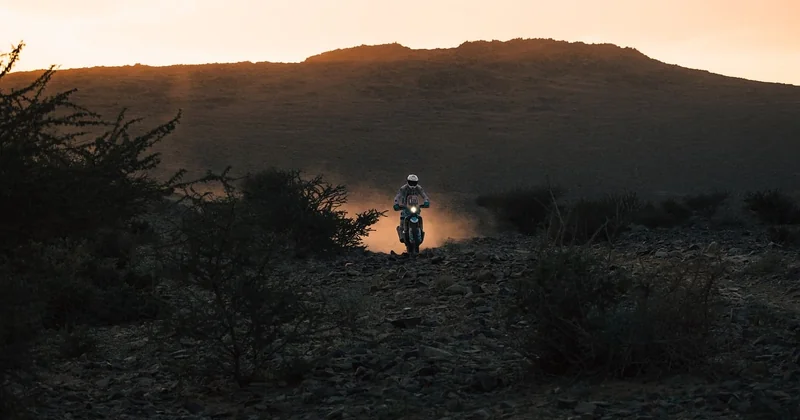
Here's a rough working scale I've settled on after a lot of trial and error:
- Under 1 litre — a tube, two tyre levers, a multitool, a patch kit. Enough for a day ride on a road bike.
- 1 to 5 litres — an overnight or a long audax. Add a light layer, food, a small battery pack.
- 8 to 15 litres — multi-day bikepacking with a bivvy or a very disciplined packing list.
- 20 to 60 litres total (both sides combined) — motorcycle touring for one rider over a week or more.
Weight matters as much as volume on a bike. A saddle bag loaded past roughly 3–4 kg on a road bike starts to sway noticeably in out-of-the-saddle efforts, and the strap-on-the-seatpost designs will swing. On a motorcycle, the concern is different: keep the heavy items low and forward, and check that the bags don't foul the rear indicators or the pillion grab rails.
The clearance test nobody runs before buying
Honestly, this is where bags fail. Not stitching. Not zips. Clearance.
Seatpost and rail compatibility
Three things to measure before you order anything for a bicycle:
- Exposed seatpost length. If you've got less than 8–10 cm of post showing above the frame, most strap-on bags will chafe the frame or sit at a bad angle.
- Saddle rail spacing. Wide, carbon-railed saddles (think short-nose road saddles) often won't accept clamp-style bags without an adapter.
- Carbon and dropper posts. Carbon seatposts are usually rated for a specific clamp torque, and many manufacturers simply advise against clamping anything to them. Dropper posts move — a bag strapped to one will either block the drop or get dragged into the tyre.
I learned point three the hard way on a gravel bike with a dropper. The bag looked fine in the workshop. On the first descent, with the post dropped, it pressed straight into the rear tyre. I rode the rest of that route with the saddle at full height and a very sore back.
Tyre clearance, mudguards and rear lights
Big tyres eat space. A 45 mm gravel tyre leaves far less room under the saddle than a 28 mm road tyre, and the bag that fits one will rub on the other. Same story with mudguards.
Then there's the rear light or radar unit. Modern radar tail lights sit exactly where many saddle bags want to hang. Check the mount position — some bags include a light clip, most don't, and taping a light to a bag flap is a temporary fix at best.
| Check | Cycling saddle bag | Motorcycle saddlebags |
|---|---|---|
| What to measure first | Exposed seatpost, rail type, tyre radius | Exhaust position, indicator width, pillion space |
| Typical volume | 0.3–15 litres | 10–30 litres per side |
| Weight limit to respect | Roughly 3–4 kg before handling suffers | Manufacturer's stated limit, often 5–8 kg per side |
| Biggest failure risk | Rubbing the tyre or frame | Heat damage from the exhaust, flapping at speed |
| Weatherproofing that matters | Sealed seams more than the fabric label | Roll-top closure or a fitted rain cover |
Materials, mounting, and what "waterproof" really means
Two bags can both say waterproof and behave completely differently in the rain. The fabric is rarely the weak point. The seams and the closure are.
Roll-top versus zip
A roll-top closure, folded three times and clipped, will keep water out in sustained rain. A zip, even a water-resistant one, will let it in eventually — usually through the stitching line above the teeth. If your riding involves real weather, roll-top is the safer bet. I've had both, and the zip bag needed a dry bag inside it within a month.
Straps, clamps and frames
Strap-based systems are universal and cheap, but they move. Clamp or bracket systems are stable but brand-specific and often expensive. For motorcycle bags, a rigid internal frame or a set of connecting straps that cross over the pillion seat makes an enormous difference to how the bag behaves above 90 km/h.
Whatever the system, do a loaded test ride before your trip. Not around the block. Twenty kilometres, with the bag packed as it will be. You'll find the sway, the rub, or the loose buckle long before it becomes a problem in the middle of nowhere.
Small bags, bikepacking setups, and the packing mistake I kept making
The best small saddle bag is the one you forget is there. That usually means under a litre, strap-mounted, with a secure closure and nothing dangling.
For bikepacking, the seat pack becomes the main volume carrier and the rules flip: now stability is everything. A large seat pack needs a rigid cradle or an anti-sway system, otherwise it pendulum-swings with every pedal stroke on a climb.
My recurring mistake was packing by category instead of by frequency. Tools at the bottom, snacks at the top, rain jacket squeezed in last and never reachable. Pack by what you'll need first — and leave 10–15% of the volume empty. Bags that are stuffed to the limit don't close properly, and a bag that doesn't close properly isn't waterproof.
Budget, brands and what you're actually paying for
Entry-level bags from large sports retailers do the job for day rides. I've used a cheap under-saddle bag for two seasons of commuting and it never let me down, because it never had to survive anything more than a drizzle.
Above that, you're paying for three things: better closure systems, more stable mounting hardware, and lighter materials. Bikepacking-specific brands charge a premium for the cradle systems that stop a large pack from swaying — and in my experience, that premium is justified if you're riding rough terrain. For a road bike and a tube, it isn't.
My honest rule: spend on the mounting system, save on the fabric. A cheap bag on a good cradle behaves better than an expensive bag strapped on with two elastic cords.
The one thing to do before you buy
Take your bike or motorcycle out to the garage, put a tape measure against the seatpost, the tyre, the exhaust, the indicators. Write the numbers down. Then buy.
It sounds dull. It takes four minutes. And it will save you the 11 p.m. hallway scene — the one where you're holding a bag that looked perfect online and wondering why nobody told you it wouldn't fit.