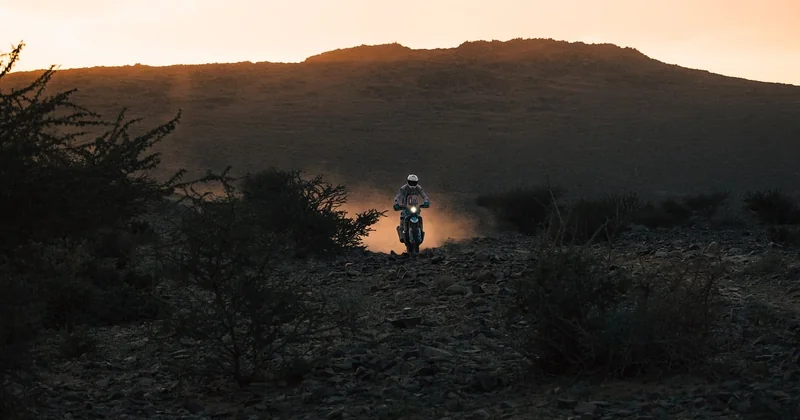
You pull off the tarmac at Agadir and within twenty minutes the sand is already finding its way into places you didn't know existed. Your visor has a fine grit film on it. The air is 44°C. And somewhere around the third hour, you realise the helmet you bought for weekend blasts is not the helmet you need for a week in the desert.
This is the point where best motorcycle helmets for long desert rides stops being an abstract shopping question and becomes a very physical one. The right helmet makes eight-hour days possible. The wrong one turns day two into a headache you can't shake, a neck that aches every time you look over your shoulder, and a visor so scratched you're riding half-blind by sundown.
Key takeaways
- Dust ingress is the real enemy in the desert — more than heat, more than noise.
- Dual-sport helmets with a proper peak and sealed vents beat pure road lids for long off-road stretches.
- A dry weight under about 1,500 g changes your endurance noticeably after six hours.
- Light colours and removable liners are not luxuries in 40°C-plus conditions.
- Your 2-2-2 check (two fingers, two straps, two-hour rule) is still the fastest safety test you can run in a camp.
Why Desert Rides Are a Different Problem for Helmets
Most helmet reviews are written for a wet-climate rider doing two hours at a time. Desert riding breaks that assumption in ways you only understand after a day of it.
Dust is the silent killer
Sand gets into every vent that isn't physically shut. It coats the top of your visor. It works its way under the inner sun-shade. On my last crossing, I had to stop every ninety minutes to clear the visor and wash the seal, because the grit was grinding into the plastic every time I flipped it down. A helmet with removable, washable liners and a visor that seals flush against the shell saves you this ritual.
Heat changes the rules
Above 40°C, a dark glossy shell turns into a solar panel. I'm not being dramatic — after three hours in direct sun, a black helmet becomes painful to touch on top. Light colours, a light-coloured liner, and a peak that casts a shadow over the visor all matter more than the last two grams of weight saving.
Dehydration is the other half of it. You'll drink more than you expect, and a helmet that makes it hard to route a hydration hose or pop up the chin bar for a drink is a helmet that makes you stop more often.
Endurance: weight and noise add up
A 1,700 g helmet and a 1,400 g helmet feel identical for an hour. By hour six, they don't. Every gram of shell weight is a gram your neck muscles have to hold at 90 km/h in crosswinds. The same goes for noise: a poorly sealed helmet that whistles will leave you with a ringing head at camp, and hearing damage is cumulative.
Bottom line: pick a helmet that treats dust and heat as core problems, not afterthoughts.
Which Type of Helmet Actually Works in the Desert?
There are three families worth considering for long desert stretches, and each has a real trade-off you need to accept.
| Type | Best for | Main weakness in desert | Weight range (typical) |
|---|---|---|---|
| Dual-sport / ADV | Mixed tarmac and gravel, long days, dusty trail heads | Peak catches wind at high speed; noise above 110 km/h | 1,400–1,700 g |
| Full-face road | Mostly tarmac, high-speed stretches, minimal dust | No peak; vents pull in dust; hot in low airflow | 1,200–1,500 g |
| Modular / flip-up | Mixed riding, need to talk at checkpoints, easier hydration | Heavier; flip mechanism can let in dust; noisier | 1,550–1,800 g |
A dual-sport helmet is the honest choice for genuine desert riding. The peak shields your visor from sun and low sun glare, and the chin bar usually has enough clearance for goggles if you go that route. The trade-off is wind noise and a bit of buffeting above 120 km/h — which, frankly, you shouldn't be doing in the desert for long stretches anyway.
If your desert trip is mostly paved roads with a bit of gravel, a good full-face road helmet with excellent ventilation is lighter and quieter. Just be honest with yourself about how much dust you'll actually ride through.
What Is the Best Motorcycle Helmet for Long Distance Riding?
The best helmet for long distance riding is the one you can wear for six to eight hours without noticing it — and that usually means prioritising fit, weight, and ventilation over brand. If it fits your head shape properly, weighs under about 1,500 g dry, and doesn't fog or cook you in the heat, it will beat a premium helmet that doesn't fit your skull.
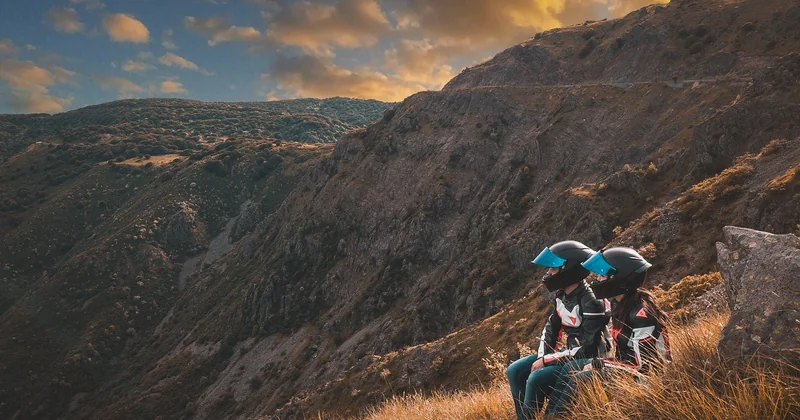
Fit is the whole game. A helmet that presses on your forehead after three hours will give you a headache that ruins the day. Spend twenty minutes in the shop with it on, or better, buy from a retailer that lets you return it after a short ride.
What is the best helmet for long rides specifically?
For long rides in hot, dusty conditions, look for a dual-sport or premium touring helmet with a removable liner, a well-sealed visor, and vents you can close in one motion. Road-oriented touring helmets with a chin curtain and good airflow also work well if your route is mostly tarmac. Avoid anything with a fixed, non-washable liner or a visor that flaps at speed.
What Is the Best Motorcycle Helmet for Hot Weather?
For hot weather, colour, liner material, and vent design matter more than the number of vents on the spec sheet. A light grey or white shell, a moisture-wicking removable liner, and a chin vent that actually pushes air up the visor are the three things that make 40°C bearable.
- Light shell colours keep the interior noticeably cooler.
- Removable, washable liners let you clean out sweat and dust every night at camp.
- A clear chin vent plus a top vent gives you airflow without pulling in dust from the wrong angle.
- Pinlock-ready visors reduce fogging when you drop from baking heat into a cold evening.
One practical trick that has saved me more than any product: carry a spare liner if you can, or wash and dry yours overnight in camp. A dusty, sweaty liner is far worse than a slightly heavier helmet.
Should You Go Dual-Sport Helmet With Bluetooth?
If you ride in a group or need navigation prompts in the desert, yes — but check heat tolerance. Lithium batteries hate 50°C interiors. Intercoms mounted on the outside of the shell fare better than units tucked inside the lining. On my last trip, a cheaper intercom mounted on the exterior survived the whole week while a premium unit in the liner shut down twice in the afternoon heat.
If you go this route, look for a dual-sport helmet with a flat, removable cheek pad area where the intercom unit can sit without pressing into your jaw after four hours.
What Is the 2-2-2 Rule for Motorcycle Helmets?
The 2-2-2 rule is a simple three-part check for helmet fit and condition: two fingers should fit between your eyebrows and the front of the helmet, two straps should be firmly done up under your chin (D-ring or ratchet), and you should replace your helmet after two hours of any single ride if the fit feels off, or after about two years of regular use if the liner has loosened.
Some riders apply the 2-2-2 rule loosely as a fit test — two fingers, two straps, two years. Whatever version you were taught, the point is to check the helmet regularly. In desert conditions, the two-year rule becomes more like eighteen months: sun, heat, and sweat degrade foam and liners faster than cool-climate riding does.
How often should you replace a helmet used in the desert?
Sooner than you'd like to think. Heat cycling, UV exposure, and grit grinding into seals all shorten the working life. If the liner has visibly loosened, the visor seal no longer sits flush, or you can feel the shell flexing more than it used to, replace it — don't wait for the calendar.
What I Actually Look For
I've made the mistake of buying a beautiful, quiet road helmet for a desert trip. It was miserable by day three: no peak, vents pulled in sand, and the liner was glued in. I've also ridden with a heavier dual-sport lid that fit perfectly — and that trip was a joy despite the extra grams.
The lesson, for me, came down to four things: fit first, weight second, dust sealing third, colour last but not least. Everything else is marketing.
The best helmet for a long desert ride is the one that has quietly disappeared by hour four — no pressure, no whistle, no fog, no sandstorm inside. If you find that helmet, you stop thinking about helmets entirely and start thinking about the road. And that, honestly, is the whole point.