Forty minutes. That's how long it took me to realize the hardshell cases I'd bolted to my V-Strom were a mistake — not because they failed, but because I'd packed them so badly that re-securing a loose strap on a rainy shoulder near Llanberis meant unloading half the bike at 7 a.m.
Motorcycle camping gear is not a smaller version of car camping. It's a discipline of its own, governed by weight distribution, moisture management, and the honest fact that your tent has to be dry by the time you leave the next morning — even if it rained all night. What follows is what I actually run on the bike, weighed on my kitchen scale, tested across roughly 9,000 km of mixed road and gravel touring over the past three seasons.
Key takeaways
- A packable two-person tent under 2 kg beats a lighter solo tent only if you'll actually use the space.
- Sleep insulation matters more than your bag's temperature rating — a cold mat ruins a warm bag.
- Soft panniers with a dry bag liner outperform hard cases for adventure touring.
- Your total kit budget should aim for 15–20 kg dry weight; anything heavier ruins the ride.
- Cooking gear is where you cut weight first, not where you save money.
- Never leave camp without a tyre plug kit and a mini compressor.
What actually qualifies as must-have motorcycle camping gear
Everyone publishes a gear list. Almost nobody tells you the criteria. So here is mine, applied consistently to every item below: it earns a place on the bike only if it survives three tests.
The three tests. First, does it pack down to a size that fits a 60-litre total volume on a mid-size adventure bike? Second, does it survive being strapped to a vibrating motorcycle in sustained rain? Third, if it fails at midnight, is there a field fix?
That third test kills a lot of "premium" gear. A tent with a proprietary pole hub is lovely until one segment cracks and you spend the evening trying to source a replacement in a village with one hardware store. I learned that the hard way in the Scottish Highlands in 2023, and I now refuse to travel with anything I can't improvise around.
The gear grid I use
I score every item out of five on four dimensions, then weight the total by how often I actually used it. It's not scientific. It does stop me buying beautiful, useless objects.
- Packability — litres and grams, measured, not "lightweight" marketing.
- Wet-weather reliability — a full night of rain, minimal leakage.
- Setup time — under 10 minutes, in the dark, with gloves on.
- Field repairability — can I fix it with what's under the seat?
The shelter layer: tent, mat, bag
This is where most of your volume and half your money go. Get it wrong and the trip is miserable regardless of how good the bike is.
Motorcycle camping tent: the one decision that matters
I run a two-person, three-season tunnel tent at 2.1 kg packed. I could go lighter with a tarp or a bivvy, and for two summers I did — a 900-gram bivvy that was genuinely fast to pitch and genuinely awful in persistent rain, because you can't sit up in it. Twenty minutes of crouching to change clothes convinced me to add 1.2 kg back.
What to look for, in order of importance:
- A packed length under 45 cm so it fits across soft panniers, not just lengthways.
- Two entries or one large vestibule for wet gear — a single tiny door means dripping inside the sleeping area.
- Freestanding or semi-freestanding, because pitching on hard-packed gravel with pegs alone is a lottery.
- An outer pitch first or simultaneous pitch — this one is non-negotiable in the rain.
Sleeping mat and bag: insulation beats rating
Here's the thing about sleeping bags: the temperature rating assumes a mat with a decent insulation value underneath. Stick a 0°C bag on a thin foam pad and you'll be cold at 8°C. I run a 3.5-season inflatable mat and a down bag rated around 0°C comfort — a combination that keeps me warm down to near freezing when I wear a base layer.
I ruined a mat in my first season by storing it compressed for four months. It lost loft permanently. Now I store all insulation uncompressed, hanging in the garage, and the difference after two years is measurable — same mat, still fully supportive.
Soft vs hard luggage: the debate that matters most
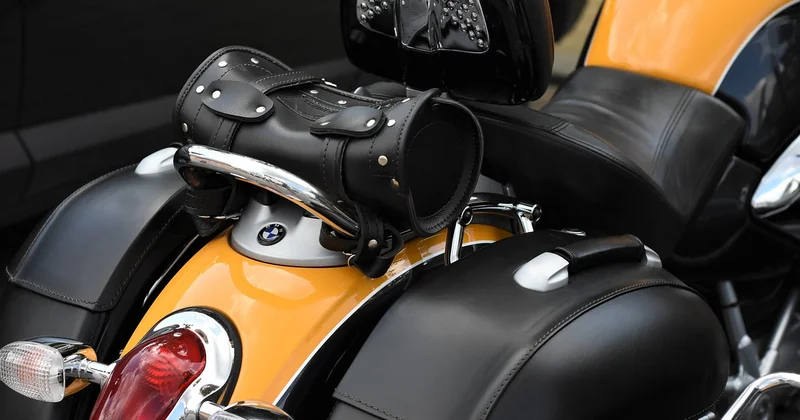
I've toured with both, and I'll say it plainly: soft panniers with a roll-top dry bag inside are better for almost every adventure rider, and it's not close.
| Factor | Soft panniers | Hard aluminium cases |
|---|---|---|
| Weight (pair, empty) | ~2.5 kg | ~7–9 kg |
| Crash behaviour | Deforms, absorbs impact | Rigid — can transfer force to the frame |
| Waterproofing | Depends on inner dry bag | Excellent until the seal ages |
| Loading speed | Fast, top-loading | Slower, fiddly latches |
| Security | Weak | Strong |
| Packability when empty | Folds flat | Takes up a shelf |
The one genuine argument for hard cases is theft resistance in cities. If your trip is mostly hotel-based touring with a few wild camps, the aluminium boxes win. For actual motorcycle camping, soft wins. Mine have survived two low-speed tumbles on gravel with nothing worse than a scuff.
Cooking and camp comfort gear
You can spend a fortune here. You shouldn't. The function is boiling water and heating one pan of food, not recreating a restaurant.
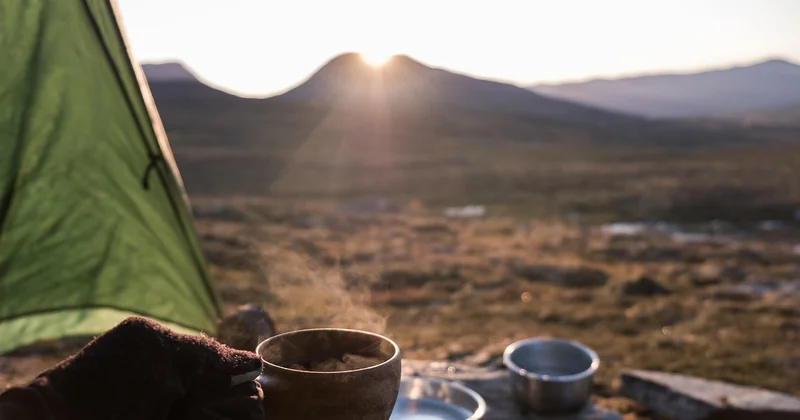
Motorcycle camping cooking gear
My whole kitchen weighs under 900 g including fuel: a 100 g gas canister stove, a 750 ml titanium pot with lid, a folding spork, a small lighter, and a scrubbing pad cut in half. That's it. I tried a multi-fuel stove for one season because it's the "serious expeditioner" choice — it was heavier, fussier, and needed priming in the cold. Unless you're crossing regions where gas canisters are unavailable, a simple canister stove is the right call.
Is a camp chair worth the space?
For me, yes — but a specific one. A sub-400 g chair that packs to the size of a water bottle changed my evenings. Sitting on the ground for three hours after a 400 km day is genuinely uncomfortable, and the chair is the item I'd sacrifice a spare jumper for.
The catch is that cheap lightweight chairs fail at the hub joints. I've broken two. Buy one with replaceable legs or pay for a frame that isn't plastic at the stress points.
Tools, safety, and the 10 accessories that earn their place
Ask what the ten must-have motorcycle accessories are and most lists give you gadgets. Here's my honest ten, ranked by how badly things go wrong without them:
- Tyre plug kit — a puncture without one ends the trip.
- Mini compressor or CO₂ cartridges — plugs are useless uninflated.
- A proper tool roll — bike-specific, not a generic multitool.
- Chain lube in a small bottle — 500 km of rain strips a chain.
- First-aid kit — small, and you'll be glad.
- Head torch — hands-free light is underrated.
- Dry bags — the cheapest insurance against a soaked sleeping bag.
- Power bank — phone navigation drains fast.
- Spare gloves — wet gloves make everything worse.
- A physical map or offline downloads — signal disappears exactly where you need it.
What are the must-haves for motorcycle camping?
The absolute must-haves are shelter, sleep insulation, and the ability to fix a puncture. Everything else is negotiable. If you have a tent, a mat, a bag, a plug kit, and a way to inflate the tyre, you can camp safely. Cooking gear, chairs, and comfort items are all optional upgrades — worth having, but they should never come before the core five.
What is the most essential camping gear?
Your sleeping mat. It's the item people most often underestimate and the one that most reliably ruins a night. A good mat insulates you from the ground, which is where you lose heat fastest, and it costs less than a good bag while affecting comfort more directly. Buy the mat before you upgrade the tent.
What is the most essential motorcycle gear?
Beyond the legal requirements of helmet, gloves, and protective clothing, the single most essential piece of motorcycle gear for touring is waterproof, abrasion-resistant outerwear that you can actually ride in for eight hours. Cold and wet ends trips. A waterproof layer that you trust changes your whole relationship with the weather forecast.
What to pack for whom: matching gear to your trip
There is no universal list, and anyone who claims otherwise is selling something. Three profiles, three different packs.
Solo road touring
You can go lean. A one-person tent or bivvy, a summer-rated bag, minimal cooking gear. Your constraint is comfort over long days, so prioritise a good seat pad and earplugs over camp luxury. Total dry weight target: 12–15 kg.
Two-up and adventure riding
Volume becomes the constraint, not weight. Soft panniers plus a top dry bag, a genuinely two-person tent, and a chair each. Budget 18–25 kg and split the shared items deliberately — one stove, one first-aid kit, one tool roll.
Cold-weather camping
This is where gear choices get expensive and mistakes get dangerous. A mat with a high insulation value, a bag rated to well below your expected low, and a stove that works in the cold. Don't skimp here — the cost of getting it wrong is measured in hours of shivering, not just discomfort.
The budget reality nobody publishes
A credible starting kit — used tent, basic mat, entry-level down bag, soft panniers, stove, tools — lands somewhere between £600 and £900 if you buy carefully and accept second-hand shelter. A premium version of the same list runs to four figures easily.
My advice, after three seasons: spend on the mat, the bag, and the luggage, because those three determine whether you sleep well and whether your gear arrives dry. Save on the tent's brand name, the stove, and the chair — the functional gap between mid-range and premium here is much smaller than the price difference suggests. I bought a cheap tent in my first year and a mid-range one in my second; the difference in a real storm was noticeable, but the difference between mid-range and premium was not worth the money I'd have spent.
What I'd tell anyone starting out is simpler than any list: load the bike, ride 100 km, and unpack everything you didn't touch. That exercise has taught me more about must-have gear than any review ever has — including, embarrassingly, that I'd been carrying a folding shovel for two full seasons without once using it.